Static vs Dynamic QR Codes: Which One Should You Choose?
By Rahul ·
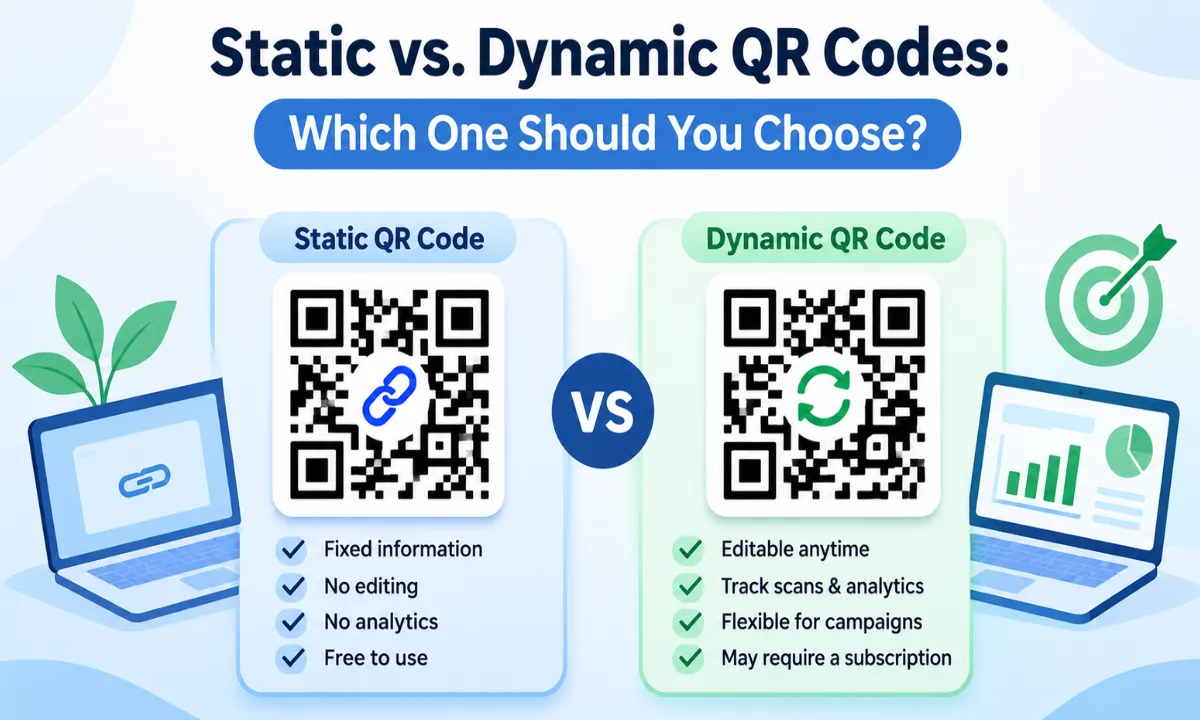
QR codes have become a common part of how businesses share information, connect with customers, and simplify everyday interactions. From restaurant menus and product packaging to business cards and marketing campaigns, they make accessing digital information much easier.
However, not all QR codes work in the same way. When creating one, you will generally come across two options: static QR codes and dynamic QR codes. Understanding the difference is important before choosing the right solution for your business.
A Dynamic qr code generator is particularly useful for businesses that want to update their QR code destination, monitor scanning activity, and manage campaigns without printing new codes every time something changes.
But does that mean dynamic QR codes are always better? Not necessarily. The right choice depends on what information you want to share, how frequently it may change, and whether you need tracking or editing capabilities.
Let's understand both options, their differences, advantages, limitations, and the situations where each one makes more sense.
What Is a Static QR Code?
A static QR code is a type of QR code that stores information directly within its encoded pattern. Once generated, the information cannot be changed without creating a completely new QR code.
For example, imagine a business owner wants to share their website address through a QR code on a visiting card. They can generate a static QR code containing their website URL.
Whenever someone scans it, their phone reads the encoded URL and opens the website.
The important thing to understand is that the destination information is embedded directly in the QR code itself. There is no requirement for an external QR code management platform to redirect the user.
How Does a Static QR Code Work?
A static QR code converts information, such as a website URL, text, contact details, or Wi-Fi credentials, into a machine-readable pattern.
The process generally works as follows:
Enter the information you want to share.
The QR code generator converts that information into an encoded QR pattern.
Download the generated QR code.
Print it or share it digitally.
When someone scans it, their device reads the information stored in the code.
Because the information is stored directly in the QR code, the scanning process does not need an intermediate redirect service for ordinary static QR codes.
Advantages of Static QR Codes
1. No recurring subscription required
Static QR codes can generally be generated and used without paying ongoing platform fees. Once created, they do not depend on a subscription-based redirect service.
2. Simple and reliable
They are useful for sharing information that is unlikely to change. Since the destination is encoded directly, there is no dependency on a third-party redirect service.
3. Suitable for permanent information
Businesses can use static QR codes for permanent website links, Wi-Fi access, contact information, and other fixed details.
4. No dependency on a QR management platform
Once generated, a static QR code can continue working without requiring the original generator to remain operational.
Limitations of Static QR Codes
Static QR codes also have limitations that businesses should consider.
No destination editing: You cannot change the encoded information after generating the code.
No built-in scan analytics: The QR code itself does not provide scan counts, locations, or device information.
Reprinting may be necessary: If the destination changes, you generally need to generate and distribute a replacement QR code.
Limited campaign flexibility: Managing multiple marketing campaigns can become difficult when every destination requires a separate printed code.
For example, if a restaurant prints a static QR code on 5,000 menus and later changes its website or menu URL, it may need to replace those printed codes.
This is where dynamic QR codes become useful.
What Is a Dynamic QR Code?
A dynamic QR code is a QR code that typically contains a short redirect URL rather than the final destination directly.
When someone scans it, the redirect URL connects to a QR code management service, which sends the user to the destination configured by the owner.
The biggest advantage is that the destination can usually be updated without changing the printed QR code.
For example, a restaurant can print one dynamic QR code on its tables. During the summer, it can redirect customers to a summer menu. Later, the same QR code can direct visitors to a winter menu.
The printed QR code remains the same. Only the destination associated with it changes.
How Does a Dynamic QR Code Work?
A dynamic QR code generally follows this process:
Select the dynamic QR code option in a QR code management platform.
Enter your destination URL.
The platform generates a unique redirect URL.
That redirect URL is converted into a QR code.
When someone scans the code, their device opens the redirect URL.
The management platform processes the request and redirects the visitor to the configured destination.
Some platforms also record scan events and provide analytics through a dashboard.
However, it is important to understand that dynamic QR codes depend on the continued availability of the redirect service. If the service becomes unavailable, the subscription expires, or the redirect URL is disabled, the QR code may stop directing users to the intended destination.
Advantages of Dynamic QR Codes
1. Edit the destination anytime
This is one of the most valuable features of dynamic QR codes.
Suppose a company prints a QR code on its product packaging. Later, it wants to redirect customers from a general product page to a warranty registration page.
With a supported dynamic QR code, the business can update the destination through its dashboard without replacing the printed packaging.
2. Track QR code performance
Many dynamic QR code platforms provide scan analytics.
Depending on the provider, you may be able to view:
Total scan events
Scan activity over time
Approximate geographic distribution
Device or operating system information
Browser information
Campaign performance
These insights can help marketers understand whether their QR campaigns are generating engagement.
Keep in mind that analytics accuracy depends on the provider's tracking methods, privacy settings, and available technical signals. A scan count does not necessarily represent a unique person.
3. Manage multiple marketing campaigns
Businesses running different campaigns can manage several QR codes from one dashboard.
For instance, a marketing agency may create separate QR codes for a product brochure, promotional flyer, event standee, and business card.
This makes campaign management more organized.
4. Reduce printing expenses
Imagine a business distributes 10,000 promotional brochures containing a QR code.
If the campaign URL changes, replacing every brochure would be expensive. A dynamic QR code allows the business to update the destination without changing the printed material.
5. Improve campaign flexibility
Dynamic QR codes are useful when marketing campaigns have limited durations, seasonal offers, changing product information, or frequently updated landing pages.
Businesses can adapt their campaigns without generating a new printed QR code every time.
Limitations of Dynamic QR Codes
Dynamic QR codes offer flexibility, but they also introduce certain dependencies.
Platform dependency: The redirect service must remain operational.
Possible subscription charges: Some providers charge for advanced features, analytics, or continued access.
Privacy considerations: Scan analytics may involve processing location, device, or other technical information.
Redirect security: If an account or redirect service is compromised, the destination could potentially be changed to an unsafe website.
Service restrictions: Some providers impose scan limits, code limits, or subscription-based restrictions.
Before choosing a dynamic QR code provider, always review its pricing, code validity, editing policies, data handling practices, and account security features.
Static vs. Dynamic QR Codes: Key Differences
Both QR code types help people access digital information, but they differ in how they store information, manage destinations, and support business requirements.
Here is a direct comparison:
Feature | Static QR Code | Dynamic QR Code |
Information storage | Directly encoded | Usually stores a redirect URL |
Destination editing | Not supported | Supported by most platforms |
Scan analytics | Not built in | Often available |
Internet dependency | Depends on the encoded content | Required for online redirects |
Third-party platform | Not required after generation | Usually required |
Printing | Permanent information is ideal | Suitable for changing campaigns |
Marketing flexibility | Limited | High |
Recurring cost | Generally free | May require a subscription |
Best suited for | Fixed information | Campaigns and changing destinations |
The main difference is simple: static QR codes are designed to share fixed information, while dynamic QR codes are designed to provide greater control over the destination after the code has been printed.
When Should You Choose a Static QR Code?
A static QR code is the better option when you want to share information that will remain unchanged.
You do not necessarily need analytics or destination editing for every QR code you create.
Here are some situations where static QR codes make practical sense.
1. Business Cards
If you want to share your permanent website URL, contact information, or email address on a visiting card, a static QR code can be sufficient.
2. Wi-Fi Access
Businesses, offices, hotels, and restaurants can use static QR codes to share Wi-Fi credentials.
Customers can scan the code and connect without manually entering the network name and password.
If the Wi-Fi password changes, however, a new static QR code will need to be generated.
3. Permanent Website Links
If you want to direct visitors to a stable website page that is unlikely to change, a static QR code is a simple solution.
4. Personal Information Sharing
Static QR codes can store contact details or other fixed information. They are useful for sharing basic information without depending on an external redirect platform.
When Should You Choose a Dynamic QR Code?
Dynamic QR codes are more suitable when you need control over the destination or want to measure how people interact with your QR campaigns.
Consider the following business situations.
1. Restaurant Menus
Restaurants frequently update their menus, prices, and special offers.
Instead of printing new QR codes whenever the menu changes, they can use one dynamic QR code and update its destination whenever required.
2. Product Packaging
Manufacturers can use dynamic QR codes to connect customers to product information, installation guides, warranty registration, or updated instructions.
For example, an electronics brand can redirect customers to the latest user manual without changing the QR code printed on its packaging.
3. Marketing and Advertising Campaigns
Marketing agencies can use dynamic QR codes on banners, brochures, posters, and promotional materials.
They can measure scan activity and change destinations according to campaign requirements.
4. Events and Conferences
Event organizers can print QR codes on tickets, invitations, and promotional materials.
The destination can be updated to show event schedules, venue information, speaker details, or registration pages.
5. Real Estate Businesses
Property consultants can place QR codes on property boards and brochures.
Instead of printing a new QR code for every listing update, they can redirect visitors to updated property details, photographs, or virtual tours.
Are Dynamic QR Codes Better Than Static QR Codes for Business?
Dynamic QR codes can offer more business value when flexibility, campaign management, and performance measurement are important.
However, better does not always mean more suitable.
Consider a small business that only wants to display its website URL on a permanent office signboard. A static QR code may fulfil that requirement perfectly.
On the other hand, an e-commerce company running multiple promotional campaigns may benefit significantly from dynamic QR codes because its offers, landing pages, and marketing destinations change frequently.
The decision should be based on the business objective rather than simply choosing the option with more features.
A useful way to evaluate your requirements is to ask three questions:
Will the destination URL change in the future?
Do you need to measure QR code scanning activity?
Will the QR code be used across multiple marketing campaigns?
If your answer is yes to most of these questions, a dynamic QR code is likely to be more suitable.
If your information is permanent and you do not need analytics, a static QR code may be the more practical choice.
Can You Convert a Static QR Code into a Dynamic QR Code?
Not directly.
A static QR code contains its original information within the encoded pattern. A dynamic QR code generally contains a redirect URL managed by a platform.
Because their underlying structures are different, you cannot simply change the type of an existing static QR code while keeping its original encoded data unchanged.
However, you can create a new dynamic QR code using the same destination URL.
For example:
Your existing static QR code contains https://example.com/menu.
You create a dynamic QR code using the same destination.
The new QR code contains a platform-managed redirect URL.
You can update its destination later through the management dashboard, if the provider supports editing.
If the existing static QR code has already been printed, it will continue to work as originally configured. The newly created dynamic QR code will need to replace it wherever destination editing is required.
Do Dynamic QR Codes Expire?
A dynamic QR code does not automatically expire simply because it is dynamic.
Its continued functionality depends on the QR code provider, subscription terms, account status, and redirect service.
Some providers offer ongoing access under free plans, while others may restrict editing, analytics, or redirects after a subscription expires.
Before printing a dynamic QR code on thousands of products or brochures, check the following:
Does the provider offer permanent or subscription-based access?
Will the QR code continue redirecting after a plan expires?
Are there monthly or total scan limits?
Can you export or transfer your QR codes?
What happens if the provider discontinues its service?
These questions are particularly important for businesses using QR codes on long-term packaging, signage, or printed materials.
Are Dynamic QR Codes Safe to Use?
Dynamic QR codes can be safe, but their security depends on the provider, account protection, and destination management.
One important consideration is that a dynamic QR code redirects users through an intermediate URL. If an attacker gains access to the management account or compromises the redirect service, the destination could potentially be changed.
Businesses should follow these security practices:
Use trusted providers: Choose a platform with a clear privacy policy, reliable infrastructure, and transparent pricing.
Enable two-factor authentication: Protect the account used to manage your dynamic QR codes.
Check destination URLs: Regularly verify that your QR codes redirect to the intended websites.
Use HTTPS destinations: Ensure that the websites receiving visitors use secure HTTPS connections.
Limit account access: Only authorized team members should be able to edit QR code destinations.
Avoid suspicious QR codes: Users should verify the destination before entering passwords, payment information, or personal details.
For businesses, QR code security should be treated as part of the overall digital security process rather than an afterthought.
How to Choose the Right QR Code Generator?
Choosing the correct QR code generator is just as important as choosing between static and dynamic QR codes.
A good platform should make QR code creation straightforward while providing the features you actually need.
Here are some important factors to consider.
1. Static and Dynamic QR Code Support
Choose a platform that clearly explains both QR code types and allows you to select the option that matches your requirements.
2. Easy Destination Management
If you are creating dynamic QR codes, check whether you can update destination URLs without generating a replacement code.
3. Analytics and Reporting
Look for useful reporting features, including scan counts, time-based activity, device information, and geographic insights where available.
4. Customization Options
A QR code generator should ideally provide options to customize colours, add logos, and adjust designs while maintaining reliable scanning performance.
Always test customized QR codes before printing them.
5. Download Quality
For professional printing, check whether the platform provides high-resolution downloads or vector formats such as SVG.
6. Transparent Pricing
Understand which features are free and which require payment. Pay particular attention to dynamic QR code validity, scan limits, and subscription restrictions.
7. Privacy and Security
Review the provider's data handling practices, access controls, and security policies before using it for business campaigns.
A QR code generator should not just create a scannable pattern. It should help you manage information effectively and provide a reliable experience for the people scanning it.
Final Verdict: Static or Dynamic QR Codes?
There is no universal winner between static and dynamic QR codes. Both serve different purposes, and choosing the right one depends on how you plan to use it.
Static QR codes are ideal for permanent information, simple sharing, and situations where you do not need tracking or destination editing.
Dynamic QR codes are a better fit for businesses that regularly update information, manage marketing campaigns, need scan analytics, or want to avoid replacing printed QR codes whenever a destination changes.
From a business perspective, dynamic QR codes offer greater flexibility for long-term marketing activities. However, that flexibility is valuable only when you have a genuine need for it and choose a reliable provider.
The smartest approach is to understand your requirements first and then select the QR code type that supports your goals.
Also read: Best Dynamic QR Code Generator for Businesses in 2026: Which One Should You Choose?
Frequently asked questions
What is the main difference between static and dynamic QR codes?
A static QR code stores information directly in its encoded pattern, while a dynamic QR code generally stores a redirect URL that connects users to a destination managed through a platform. Static destinations cannot be edited, whereas dynamic destinations can usually be updated without changing the printed code.
Which QR code is better for marketing campaigns?
Dynamic QR codes are generally more suitable for marketing campaigns because they allow businesses to update destinations and access scan analytics, depending on the provider's features.
Can a dynamic QR code be edited after printing?
Yes. Most dynamic QR code platforms allow users to change the destination URL through a dashboard without replacing the original printed QR code.
Do static QR codes need an internet connection?
Not always. Static QR codes containing plain text, contact details, or Wi-Fi credentials can be read without an internet connection. However, opening an encoded website URL requires internet access.
Are static QR codes free?
Many QR code generators allow users to create static QR codes for free. Once generated, a standard static QR code does not require an ongoing subscription to keep its encoded information accessible.
Do dynamic QR codes need a subscription?
Not necessarily. Some platforms offer free dynamic QR codes with limited features, while others require subscriptions for advanced analytics, editing, or higher usage limits. Always review the provider's terms.
Can I track how many people scan my QR code?
A standard static QR code does not provide built-in analytics. Dynamic QR code platforms can record scan events and provide reporting features, although the information available varies between providers.
Can I use the same dynamic QR code for multiple campaigns?
Yes, if your provider supports destination editing. You can reuse the same printed QR code and update its destination for different campaigns. However, this replaces the previous destination rather than creating separate historical versions automatically.
Which QR code is best for product packaging?
Dynamic QR codes are often more useful for product packaging when businesses need to update product information, manuals, warranty pages, or promotional destinations. Static QR codes are suitable when the encoded information is permanent.
How can I create a dynamic QR code?
You can use an online dynamic QR code generator. Select the dynamic option, enter your destination URL, generate the QR code, and download it. If the platform provides a management dashboard, you can use it to update the destination and monitor available scan analytics.